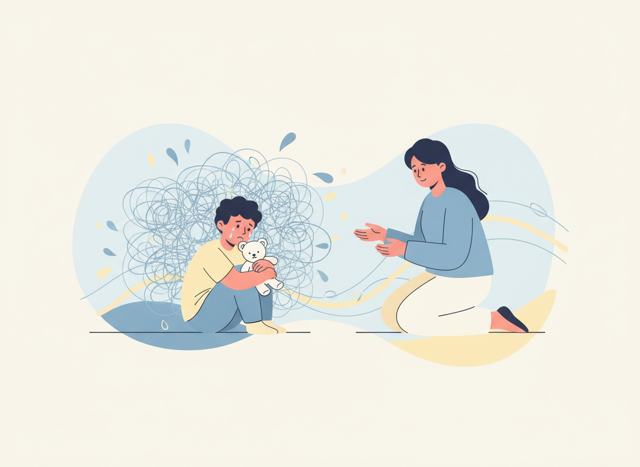
Fear or Anxiety? When It’s Normal and When It May Signal a Disorder
Fear and anxiety are a natural part of growing up, but they can become a problem when they are intense, persistent, and begin to restrict a child’s everyday life.
Fear and anxiety are a natural part of growing up. Children may be afraid of the dark, separation, school, or social situations, and this often falls within typical development. The difficulty begins when anxiety becomes so intense and persistent that a child starts avoiding everyday activities, loses a sense of safety, and their life becomes increasingly restricted.
In clinical practice, it is important to distinguish developmental fears (which appear and pass) from anxiety disorders (which persist, intensify, and impair functioning).
Fear vs. anxiety
-
Fear is most often linked to a specific object or situation (e.g., a dog, an injection, the dark). It is usually short-lived and happens in the here and now.
-
Anxiety is broader: it can be linked to an object, but it can also be diffuse, accompanied by ongoing worry, anticipation, and tension.
Anxiety is often accompanied by physical symptoms (autonomic nervous system): rapid heartbeat, sweating, nausea, stomach aches, headaches, dry mouth, hot/cold sensations, trembling, and muscle tension.
Typical (developmental) fears by age
These fears can occur without an anxiety disorder:
-
0-2 years: loud noises, strangers, separation
-
3-6 years: imaginary creatures, the dark, sleeping alone, doctors, storms
-
6-12 years: school performance, illness, social situations
-
13-18 years: social evaluation, self-esteem, body image, growing up
Developmental fears usually:
-
do not last long
-
do not take over daily life
-
decrease with support and experience
When to suspect an anxiety disorder
Consider an assessment if fears and worries:
-
last longer than a few weeks and tend to intensify
-
are not age-appropriate or are clearly excessive
-
cannot be reduced even with support
-
lead to avoidance (school, activities, socializing, sleeping)
-
cause pronounced physical symptoms or frequent medical visits without a clear physical explanation
-
significantly affect the family (tension, organizing life around the fear)
Red flags (when it helps to seek support sooner)
-
sudden decline in functioning (school, sleep, relationships)
-
episodes of intense fear/panic
-
regression (bedwetting again, strong need to stay close to a parent)
-
prolonged school avoidance or social isolation
-
comorbid symptoms of depression, irritability, or self-harm
Why avoidance helps short term but maintains anxiety long term
When a child avoids a feared situation (e.g., school, sleeping alone, answering in class), anxiety decreases in the moment. The brain learns that avoidance is the solution, so avoidance tends to increase over time. That is why treatment often focuses on gradual re-engagement with feared situations, with safety and support.
What parents can do right away
-
Don’t dismiss the fear, but don’t dramatize it either.
-
Don’t blame the child (anxiety is not a choice).
-
Encourage gradual exposure, not avoidance.
-
Notice patterns: when symptoms appear, what increases them, what helps.
How to talk to your child (example phrases)
Helpful phrases:
-
I can see this is hard for you. I’m here.
-
The fear feels real, but it doesn’t necessarily mean there is real danger.
-
We’ll take small steps, together.
Phrases that often don’t help (even when well-intended):
-
It’s nothing.
-
There’s nothing to be afraid of.
-
If you’re scared, you don’t have to go.
When is a psychological assessment enough, and when is a psychiatric assessment important too?
-
A psychological assessment can help us understand the pattern of worries/fears, triggers, strengths and difficulties, and plan an appropriate psychotherapy approach.
-
A psychiatric assessment is important when symptoms are intense and persistent, when functioning is significantly impaired, when there is suspicion of comorbidity (e.g., depression, OCD), or when considering medication as part of treatment.
Booking and intake form
If you feel that anxiety is making everyday functioning difficult for your child or adolescent (school, sleep, relationships, activities), an assessment can be a helpful first step toward a clear plan of support.
-
Appointments: +385 91 605 84 76
-
Website: https://www.poliklinikagoldenmind.hr
Booking form (copy/paste into an email):
-
Child/adolescent full name:
-
Age:
-
Reason for reaching out (1-2 sentences):
-
How long symptoms have been present:
-
School/grade (optional):
-
Any previous assessment or therapy (yes/no):
-
Parent/guardian contact phone:
-
Preferred time (morning/afternoon) and days (if known):
Note: This text is for informational purposes and cannot replace an individual clinical assessment.